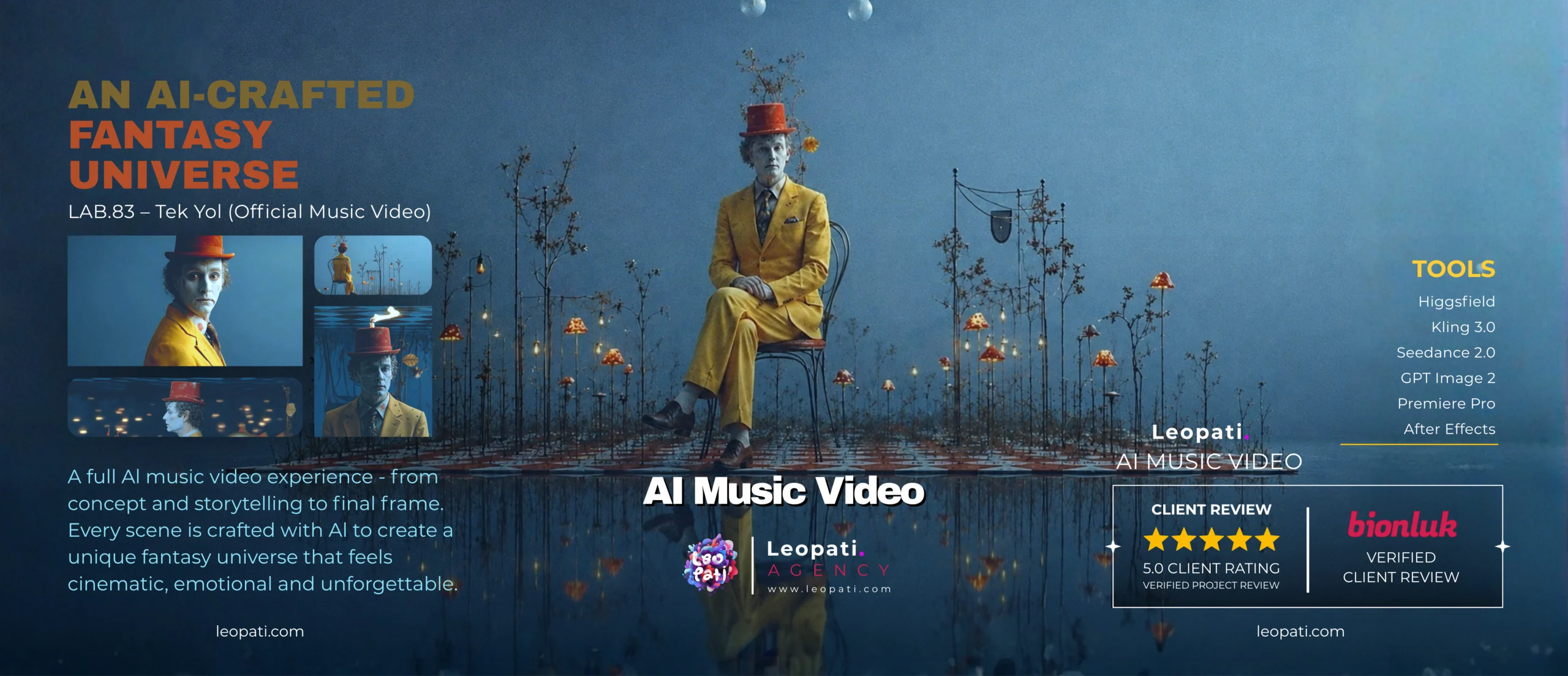
AI Music Video Generator vs Professional Production: Which Workflow Fits?
Use an AI music video generator for fast, low-budget social clips, proof-of-concept visuals or mood tests. Hire a professional studio when you need consistent character performance, controlled lighting/lens language, complex VFX, label/distributor delivery standards or clear legal/rights management. Often the best result is a hybrid workflow: generator for ideation and previs, studio for polish and final masters.

Quick comparison (what changes between them)
- Speed: Generators can produce a shareable clip in minutes to days. Studios require weeks for direction, iteration and final delivery.
- Cost structure: Generators are lower-cost per draft but can incur hidden costs for high-resolution, extended usage or licensing. Studios have higher upfront costs but deliver production-grade masters and rights management.
- Creative control: Studio workflows offer precise control over framing, motion, continuity and performance. Generators excel at rapid experimentation but struggle to guarantee frame-to-frame consistency and complex choreography.
- Continuity and narrative: Professional teams deliver consistent characters, thematic continuity across scenes and reliable lip-sync/beat-accurate cuts. Purely generated outputs can shift style or character between prompts.
- Rights and delivery: Studios provide clear handover files (ProRes, stems, edit decision lists) and can manage talent releases. Generators vary widely in licensing and may not cover commercial or exclusive rights.
When an AI music video generator is enough
- You need a fast social-first visualizer or animated cover for TikTok/Instagram reels.
- You’re producing concept reels, mood boards or pitch clips to test direction before committing budget.
- Budget is extremely limited and quality expectations are modest (lo-fi, experimental, or intentionally glitchy aesthetics).
- You want multiple rapid variations for A/B testing where pixel-perfect continuity isn’t required.
Practical note: For short-form clips under 30–45 seconds, where the goal is reach rather than long-term catalog quality, generators are often a sensible first step.
When you should hire a production studio
- You require consistent characters, live performers, choreography or lip-sync across multiple scenes.
- The project must meet label/streaming technical and legal delivery standards (masters, stems, ISRC-ready assets, metadata-ready files).
- You need high-resolution masters, color grading, camera emulation or specific lens/lighting continuity.
- The music video is a flagship release that represents a brand or catalogue and will be used across paid placements, broadcast and long-term distribution.
- You require clear ownership and talent release documentation for likenesses, brand integrations, or product placement.
Hybrid workflow: combine speed with production control
A common and efficient workflow blends both approaches:
– Ideation & storyboarding: Use generators to create style frames and rapid concept variants.
– Previs: Generate rough scene sequences to test beat hits, camera motion and timing.
– Directed production: Use the approved generator-based treatment as a blueprint for a studio shoot or directed AI production pass.
– Final delivery: Let the studio produce polished masters, finalize color grading, motion stabilization and deliver stems and archival assets.
This hybrid approach reduces creative risk, shortens iteration cycles and ensures final deliverables meet distribution and rights requirements.
Practical decision checklist (ask these before you choose)
- What is the primary platform and required file specs (resolution, codec, duration)?
- Is frame-to-frame continuity and performer likeness required?
- Who owns the final rights and do you need talent releases?
- What is your turnaround time and iteration budget?
- Will you need stems, masters and multi-format deliverables for streaming, broadcast and paid media?
If the checklist leans toward rights, continuity and long-term catalog use, favor a studio-directed workflow or hybrid approach.
Deliverables to expect from each option
- Generator-first: MP4 drafts, style frames, prompt records, lower-resolution masters (confirm licensing).
- Studio-led: High-quality masters (ProRes), audio stems, edit decision list (EDL/AAF), color-graded files, delivery notes and rights paperwork.
Next steps and further reading
If you’re deciding for a specific release, map your distribution needs, timeline and budget against the checklist above. For guidance on production processes and agency selection, see our AI Music Video Production and AI Video Agency pages. For tool choices, cost planning and workflow templates, check Tools, Cost and Workflow resources.
FAQs
When is an AI music video generator the fastest route?
For short social clips, proof-of-concept visuals or rapid A/B test variants where continuity and legal ownership aren’t priorities, generators can be the fastest route—often delivering a shareable visual in hours to a few days.
Can a generated video be used as the final master for distribution?
Sometimes—only if the generator’s licensing covers commercial usage and the output meets platform technical specifications. For label-grade releases and long-term catalog use, studios typically provide the necessary masters and documentation.
How do hybrid workflows reduce risk?
They use generators for ideation and previs, then move to a studio for controlled shoots or premium AI passes. This reduces expensive re-shoots and ensures final files, rights and masters meet distribution needs.
Will an AI generator keep a character consistent across a 4-minute video?
Purely generative pipelines often struggle with long-form, frame-to-frame character consistency and lip-sync. Achieving reliable consistency usually requires directed production, version control and human-managed assets.
What should I ask an agency before hiring for an AI music video?
Ask about deliverables (ProRes, stems, EDL), rights and releases, revision process, timeline, and examples of projects with similar scale or format.
Frequently asked questions
When is an AI music video generator the fastest route?
For short social clips, proof-of-concept visuals or rapid A/B test variants where continuity and legal ownership aren’t priorities, generators can be the fastest route—often delivering a shareable visual in hours to a few days.
Can a generated video be used as the final master for distribution?
Sometimes—only if the generator’s licensing covers commercial usage and the output meets platform technical specifications. For label-grade releases and long-term catalog use, studios typically provide the necessary masters and documentation.
How do hybrid workflows reduce risk?
They use generators for ideation and previs, then move to a studio for controlled shoots or premium AI passes. This reduces expensive re-shoots and ensures final files, rights and masters meet distribution needs.
Will an AI generator keep a character consistent across a 4-minute video?
Purely generative pipelines often struggle with long-form, frame-to-frame character consistency and lip-sync. Achieving reliable consistency usually requires directed production, version control and human-managed assets.
What should I ask an agency before hiring for an AI music video?
Ask about deliverables (ProRes, stems, EDL), rights and releases, revision process, timeline, and examples of projects with similar scale or format.