AI Video Generator vs AI Production Company: Cost, Control and Delivery
An AI video generator is a fast, low-cost tool for experiments, prototypes and high-volume social content. An AI production company adds creative direction, continuity, editorial finish and accountability—essential when brand identity, legal clearances, campaign performance or cross-format delivery matter. Choose a tool for iteration and scale; choose a studio when outcomes must be consistent, on-message and ad-ready.
Quick decision guide
- Use an AI video generator when you need: rapid concept tests, low-cost variations, social clips, or internal prototyping with minimal sign-off burden.
- Hire an AI production company when you need: consistent brand identity, multi-asset delivery, editorial quality, legal/safety checks or a project owner who accepts responsibility for final assets.
Head-to-head comparison
| Dimension | AI video generator (tool) | AI production company (studio) |
|---|---|---|
| Cost per minute | Low on a per-asset basis; predictable subscription or token costs | Higher: includes creative time, project management, revisions and delivery specs |
| Speed | Very fast for single outputs; instant iteration | Fast for managed workflows, but includes planning and review cycles |
| Creative control | Direct but often limited to prompt-level control; consistency is manual | Direction from creatives, style guides, revisable shot lists, version control |
| Continuity & consistency | Difficult to guarantee across scenes/episodes | Managed with templates, reference frames and editorial oversight |
| Editorial finish | Raw outputs often need compositing, color, audio work | Delivered with edit, grade, sound mix and masters for platforms |
| Accountability | User responsible for legal, brand and performance outcomes | Studio accepts delivery responsibility and coordinates legal/clearance steps |
| Best use cases | Prototyping, A/B tests, high-volume UGC-like clips | Campaigns, product films, ads, branded content and long-form work |
When a tool is the smart choice
- You need dozens of quick social variants to test hooks or thumbnails.
- Your brand risk tolerance is high and you can absorb a few imperfect outputs.
- You’re exploring visual concepts or mood boards internally before committing budget.
- The project is experimental, short-lived, or intended for a non-commercial channel.
Tips: standardize prompts in a shared doc, export raw assets to a simple edit timeline, and tag successful prompts for reuse.
When to hire an AI production company
- Brand consistency matters across formats (TV, YouTube, Reels, OOH).
- You require integrated audio, licensed music, or a finished sound design.
- The campaign needs legal clearance, model releases or location-like continuity.
- You want one accountable partner who manages brief, revisions and final masters.
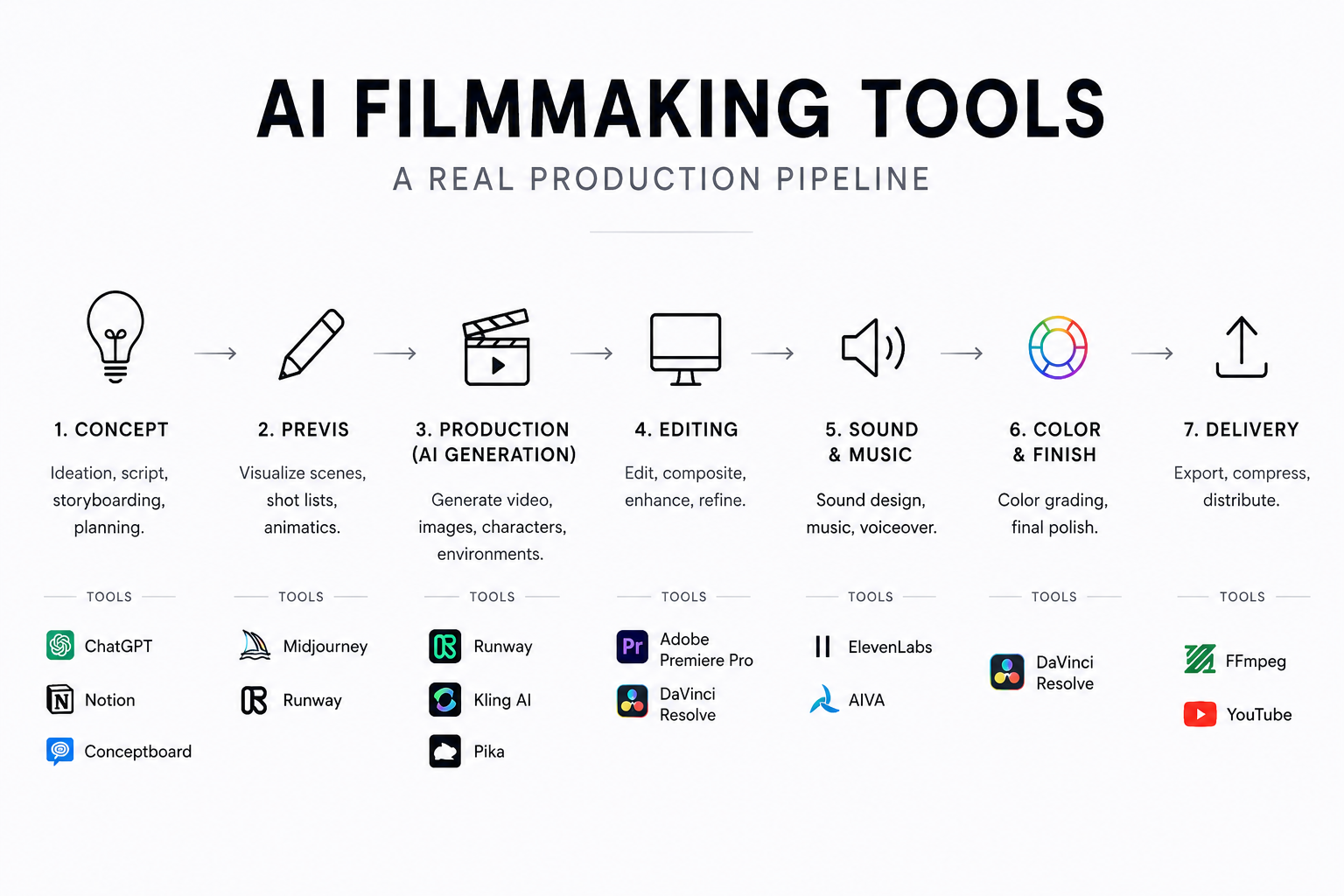
A production company connects creative direction to technical pipeline: they translate brand strategy into repeatable prompts, run controlled generation, composite and grade footage, and deliver platform-specific masters.
Cost and delivery considerations (practical planning)
- Budget: Factor in creative hours, review cycles, and final-mastering when comparing to a generator’s nominal cost.
- Revisions: Generators can iterate quickly but lack reliable versioning; studios include controlled revision windows and archive assets for future tweaks.
- IP & compliance: Tools often leave legal responsibility with the user; studios can help with licensed audio, clearable likenesses and contractual guarantees.
How to choose for your brief
- Define the audience and tolerance for variation (high for internal testing, low for brand campaigns).
- List required deliverables (ratio of raw clips vs final masters for each platform).
- Assess legal or safety needs (music licensing, likeness, regulated content).
- Run a short experiment: generate 3 concepts with a tool, then brief a studio to re-create the best-performing concept. Compare time, cost and quality.
This approach uses the speed of tools for ideation while keeping studio workflows for any asset that must perform under brand or legal constraints.
Example workflows (two streamlined options)
- Prototype-first: use AI generator to produce mood clips → select the best → brief studio for continuity, compositing and final delivery.
- Studio-first: brief studio for direction and brand-safe assets → studio uses controlled generation and post-production to deliver finished masters.
Next steps
If your brief needs consistent brand execution, cross-format delivery and a single accountable partner, talk to a production partner. For quick tests and volume, a generator may be enough.
Suggested internal reads: What to Look for in an AI Video Production Agency (/what-to-look-for-in-an-ai-video-production-agency/), AI Commercial Production Cost (/ai-commercial-production-cost-what-brands-should-budget-for/), and AI Music Video production notes (/ai-music-video/).
If you’d like, Leopati can help scope an experiment that uses both approaches so you can measure cost-per-concept versus cost-per-deliverable before committing to a full campaign.
Production checklist for AI video generator vs production company
A successful AI video project starts with a brief that defines the audience, the intended action, the visual reference point, the required duration and the delivery formats. In AI Video Generator vs AI Production Company: Cost, Control and Delivery, these details determine which parts of the production can be generated, which parts benefit from live-action or practical plates, and where human creative direction is essential.
Teams should plan for test frames, review gates, continuity checks, editing, colour, sound and platform delivery from the beginning. The purpose of a production partner is to turn a promising generative idea into a repeatable process with clear decisions and a finished master. That approach protects quality while keeping the workflow flexible enough to explore different visual directions.
What to confirm before production
Every brief benefits from an explicit decision record. Confirm the audience, the intended viewing context, the emotional or commercial outcome, the references that define the visual language, and the parts of the image that must be exact. Then identify the elements that can remain exploratory. This makes review faster because the team knows which changes protect the brief and which changes are simply aesthetic alternatives.
It is also useful to define what “finished” means before work begins. That may include a locked duration, a clean master, social cutdowns, subtitles, audio stems, colour-managed exports, a rights and likeness review, or an editable handoff. Clear acceptance criteria reduce unnecessary generation cycles and make AI production easier to compare with a conventional production workflow.
Frequently asked questions
Are outputs from AI generators usable for paid ads?
Yes—but with caveats. Generators can produce ad-ready visuals quickly, but most outputs will need editorial finishing (grade, safe titles, audio mix) and legal checks for likenesses and trademarks. For paid campaigns where performance and compliance matter, a production company typically provides safer, platform-optimised masters and accepts accountability for delivery.
How do studios ensure consistency when using generative tools?
Studios use reference frames, style guides, reusable prompt libraries, seed files and controlled pipelines. They also composite, color-grade and perform editorial passes so separate generated shots match in tone, timing and framing—something that is difficult to guarantee from ad-hoc generator outputs alone.
Which is cheaper overall: using a generator or hiring a studio?
Per-asset, generators are cheaper. But when you include creative direction, revision rounds, final mastering, legal clearances and multi-format delivery, studios can be more cost-effective because they reduce rework and campaign risk. Budget decisions should account for the total cost to get a campaign live, not just raw generation fees.