Who is Leo?
Meet Leo: our studio mascot and Chief Paw Officer
Leo is Leopati's beret-wearing leopard cub. He lives in the corner of our screens, gets us away from the desk every 25 minutes, and reminds us why we do this work while we walk.
Leo's 25 + 5 rhythm matches the only break pattern that lowered the post-meal blood sugar response in Duran et al. (2023): 5 minutes of walking every 30 minutes.
“Good films don't start at the desk. They start on a walk.”
LeopatiCrew pass

Leo
Mascot · Chief Paw Officer
- Shift
- 25 min focus, 5 min walk
- Pay
- Spots
- Reports to
- Güneş Polater
- Joined
- November 2026
Software character · Not a person · Not an AI
Why Leo exists
AI filmmaking means long hours at the screen: generating shot by shot, selecting, editing, grading. Once the work flows, the hours disappear.
We believe AI replaces the shoot, not the direction. Direction needs fresh eyes and a rested mind, so we built someone to remind us every day.
That makes Leo a working rule rather than a preference: everyone at Leopati works with Leo. Great creative work comes from a healthy, rested team.
What the science says
Leo's rhythm isn't a guess. In a controlled trial of different sitting-break patterns, the only one that significantly lowered the post-meal blood sugar response was 5 minutes of light walking every 30 minutes (Duran et al., 2023).
The link between sitting and heart health goes back to 1950s studies of London bus drivers and conductors.
| Study | What was tested | Finding | In Leo |
|---|---|---|---|
| Duran et al., 2023, Columbia University | 11 adults, 8 hours of sitting, 4 walking-break patterns | Only 5 minutes every 30 minutes lowered blood sugar; all break patterns lowered systolic blood pressure (at most about 4-5 mmHg) | The 25 + 5 cycle |
| Carter et al., 2018, Journal of Applied Physiology | 15 desk workers, 4 hours of sitting | Uninterrupted sitting reduced blood flow to the brain; 2-minute walks every 30 minutes prevented it, one 8-minute walk every 2 hours did not | Short, frequent breaks rather than one long one |
| Fenesi et al., 2018, McMaster University | 50-minute lecture with exercise breaks, video game breaks or no breaks | Students who moved during breaks paid more attention and remembered the material better 48 hours later | A break gives focus back |
| Morris and Raffle, 1954; Heady et al., 1961 | London bus crews: seated drivers, stair-climbing conductors | Heart disease was more severe in drivers, and the difference held among men with the same waist size | The cost of sitting still has long been known |
Most of these studies are small and short-term, and Leo is not a health product. It turns what the research points to into a daily habit.
What Leo does
- 25 min focus
- 5 min walk
- 15 min long break
Runs a focus and walk rhythm.
25 minutes of focus, then a 5-minute walk. Every fourth round, a 15-minute long break.
Starts on his own.
He notices when you start working and starts the timer. Step away and he pauses.
Stays out of the way.
He hides while you focus and peeks in 2 minutes before a break. Keep typing and he steps back. In meetings he stays quiet.
Gives each break a small task.
Drink water, stretch your shoulders, look into the distance, walk without your phone.
Reminds you why you walk.
Each break shows Leopati's vision, goals and lines the team wrote themselves.
Turns it into a game.
Every walk earns Leo a spot. Five spots and he levels up, unlocking a new accessory: clapperboard, red scarf, director's glasses, headphones, the Golden Leo award. Four walks a day keeps the streak alive.
Respects time off.
Watching a film or doing something else? Switch to Private time and Leo goes quiet. No need to quit him.
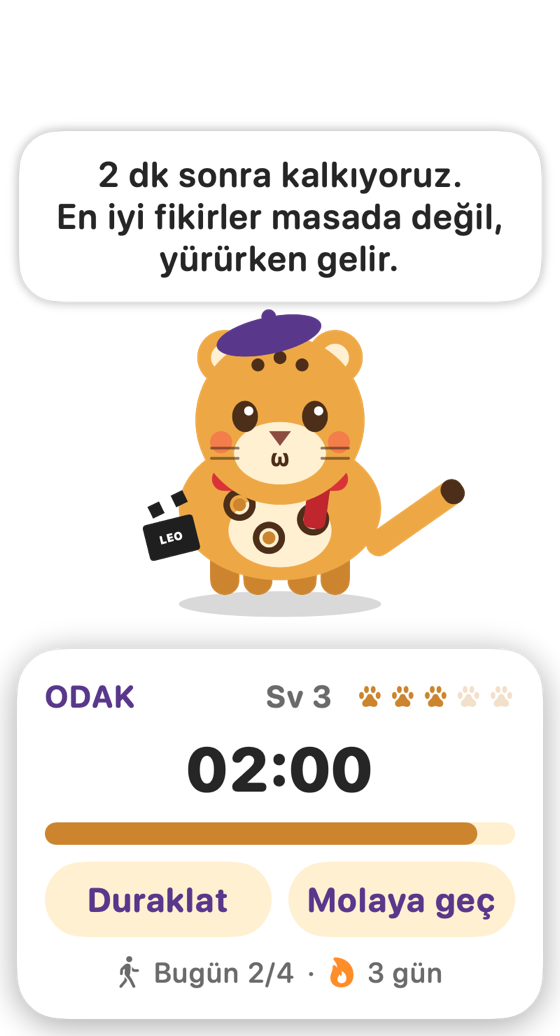
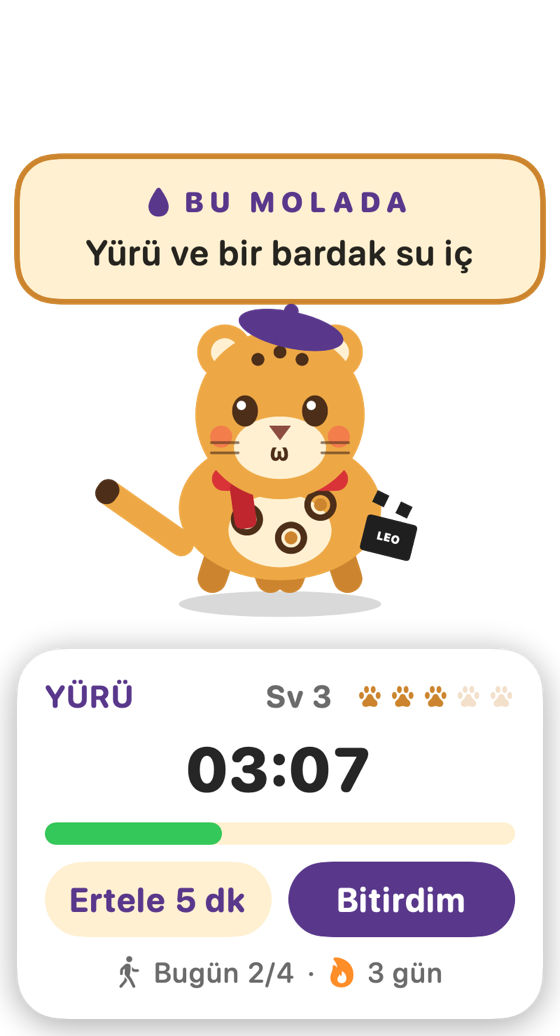
The numbers on screen are examples.
Promotions
Five walks, one level
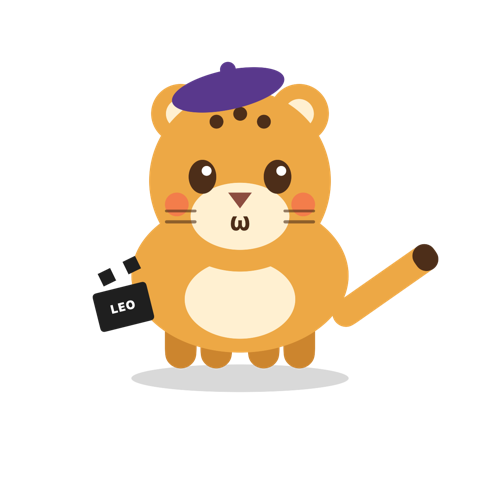
Level 2
Clapperboard
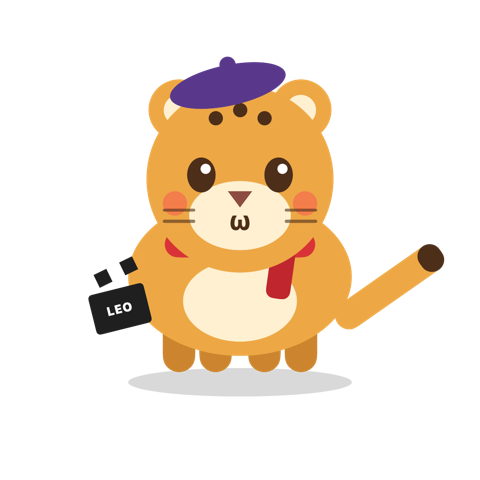
Level 3
Red scarf

Level 4
Director's glasses

Level 5
Headphones

Level 6
Golden Leo award

Level 7
Chest star
Mascot and team member
A mascot, because Leopati's name and spirit come from him: a leopard, a paw, and a director's beret. A team member, because he does real work every day: protecting the team's health, the quality of our focus, and the studio's long-term goals.
Like NOVA and ATLAS, Leo was developed in-house and reports to Güneş Polater. He isn't a person, but he is the most persistent one on the team.
Why Leo is an innovation
Leopati doesn't wait for the tools it needs; it builds them. NOVA and ATLAS speed up production, and Leo protects the people doing it.
- Turns research into habit. A finding that stayed in journals became a rhythm that runs itself.
- Makes it a game. Spots, levels, accessories and streaks make it something the team wants to play.
- Protects focus. He never takes keyboard focus, goes quiet in meetings and pauses when you leave the desk.
- Respects privacy. He runs entirely on the computer with no data leaving it.
- Carries the brand into the work. The lines he shows are Leopati's own vision and goals.
A studio's most valuable equipment isn't its cameras or computers. It's the people using them, and Leo acts on that every 30 minutes.
Why it matters to our clients
Your project is directed by a rested team. We want the decisions in the last frame of a long production to be as clear as those on day one. Leo is a daily, visible sign that we take the craft seriously.
FAQ
What is Leo?
Leopati's mascot and Chief Paw Officer. A small desktop app that keeps us to 25 minutes of focus followed by a 5-minute walk.
Does everyone at Leopati use Leo?
Yes. Everyone on the Leopati team works with Leo. It's a studio rule, because our team's health and the quality and creativity of our work come from the same place.
Why did you build him?
AI filmmaking keeps us at the screen for hours. A generic notification is easy to dismiss. Ignoring a character you love, one that belongs to the studio, is much harder.
What does he do?
Three things: gets us up from the desk regularly, protects our focus time, and shows the studio's vision and goals at every break.
Why does it matter?
A film is only as good as the decisions of the person directing it. A tired mind makes rushed decisions. Leo is part of how we stay sharp through long productions.
Do you really need it?
We do. Our most valuable resource is our team's health and attention. That's why everyone at Leopati works with Leo. We don't treat sitting for hours without a break as an achievement. Regular breaks are part of the job.
Is sitting really that harmful?
The effects of long, uninterrupted sitting are measurable. In a study of desk workers, 4 hours of uninterrupted sitting reduced blood flow to the brain, and 2 minutes of walking every 30 minutes prevented the drop (Carter et al., 2018).
Why 25 minutes of focus and a 5-minute walk?
Leo's 25 + 5 rhythm matches the only break pattern that lowered the post-meal blood sugar response in Duran et al. (2023): 5 minutes of walking every 30 minutes. 25 + 5 is also the familiar Pomodoro rhythm, so we combined the two.
Don't breaks hurt productivity?
The opposite. In a McMaster University study, students who did short exercise breaks during a 50-minute lecture paid more attention and remembered the material better 48 hours later (Fenesi et al., 2018).
Where does Leo's data go?
Nowhere. Leo runs entirely on the computer; walk history, streaks and goals stay on the device.
What is the goal?
A healthy working rhythm we keep every day without getting bored of it. Leo turns it into a game: a spot for every walk, an accessory for every level, a streak for every day.
Is Leo a person or an AI?
Neither. Leo is a desktop app and a character developed at Leopati. Like NOVA and ATLAS, he is part of our team and reports to Güneş Polater.
Doesn't he distract you?
No, he was designed not to. He hides during focus, never interrupts typing, and stays quiet in meetings. He only appears close to and during breaks.
Why a leopard, and why a beret?
The name Leopati comes from leopard and paw. The beret stands for directing. Leo is like the studio itself: productive, curious and a little stubborn.
Can I use Leo too?
Soon. Leo currently works with the Leopati team, and we're planning a version our clients can use in their browser or on their computer. Write to us to hear when it's ready.
Sources
- Duran et al., 2023. Med Sci Sports Exerc.
- Carter et al., 2018. J Appl Physiol.
- Fenesi et al., 2018. J Appl Res Mem Cogn.
- Morris and Raffle, 1954. Br J Ind Med.
- Heady et al., 1961. Br J Prev Soc Med.