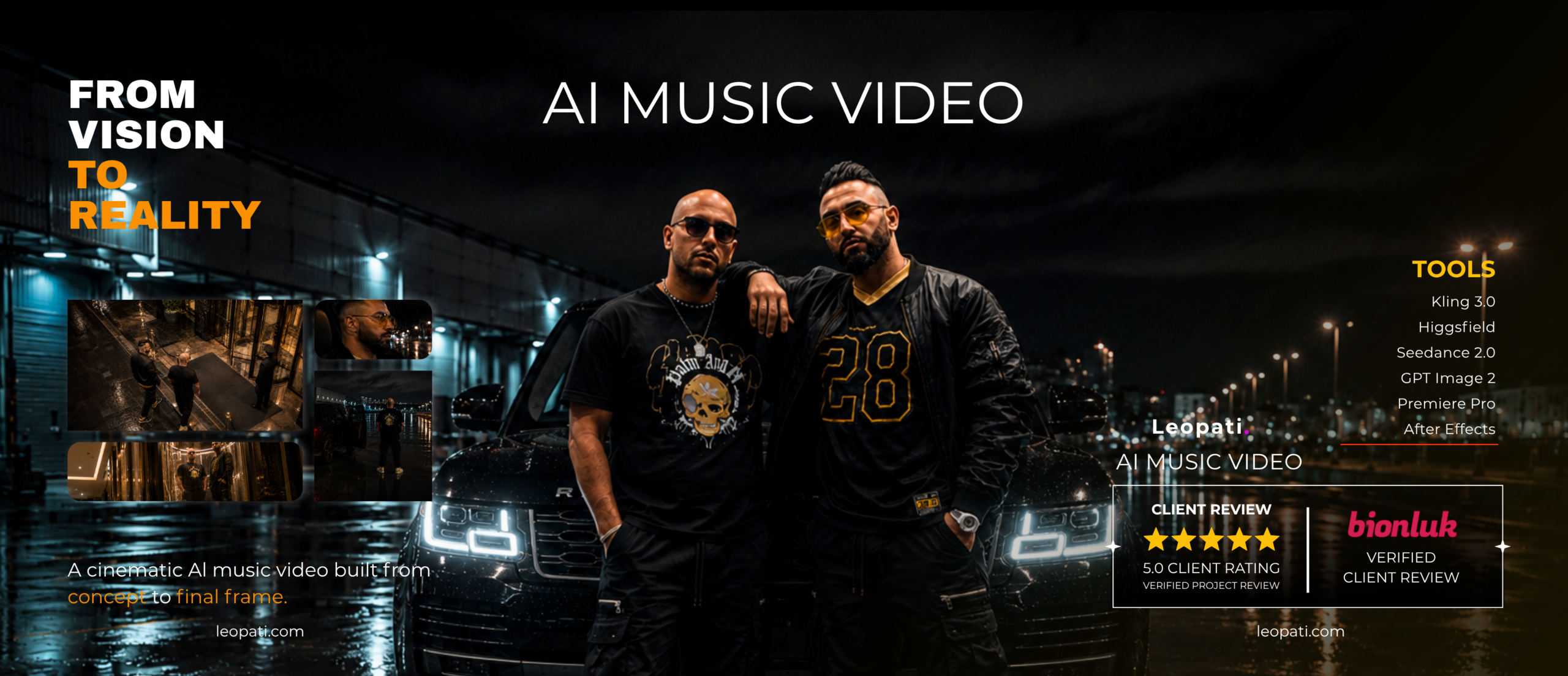
Leopati designs campaign-led AI video productions that combine cinematic identity with production proof: world-building, talent-led visuals, and deliverables scaled for social, streaming and broadcast. We translate IP and artist aesthetics into a coherent video system—style frames, custom models, scene bibles and platform-ready edits—while managing likeness, rights and iterative creative control.
Why entertainment brands use directed AI production
AI accelerates ideation and visual iteration, letting teams test multiple cinematic directions quickly. For entertainment brands and artist campaigns the value is less about cost-cutting and more about speed, creative exploration and consistent world-building: think a branded music video and a set of vertical cuts, teasers, lyric visuals and performance loops that all share a single cinematic identity.
What a campaign-first AI video production includes
- Creative direction & campaign strategy: target platforms, release windows, and audience hooks.
- World-building & identity: moodboards, style frames, color systems and a scene bible that define the campaign’s visual grammar.
- Asset production: AI-generated scenes, custom character/talent references or fine-tuned models, live-action integration where required, and high-quality rendered passes.
- Post & versioning: color-grade, VFX polish, audio-sync, and platform-specific edits (short-form, 9:16 vertical, 16:9, broadcast-ready).
- Deliverables & playbook: guidelines for in-market asset adaptation and reuse across channels.
Deliverables tailored for artists and IP-driven campaigns
Entertainment productions need more than a single clip. Typical campaign deliverables include: a flagship cinematic short or branded music video; 4–8 short-form cuts for social; animated lyric or visualizer variations; hero still frames and motion assets for posters and ads; and a visual playbook so label, agent and channel teams can produce follow-ups with consistent identity.
Protecting likeness, rights and IP
Using an artist’s likeness or a licensed IP requires clear rights and releases. Directed production services are collaborative: the creative team handles technical consistency and version control, while legal teams and rights holders provide clearances. Before any likeness-driven generation we recommend obtaining written permissions and keeping a record of consent for each generated derivative.
Cinematic identity + production proof (our differentiation)
Campaign thinking means the production exists to perform in market—not just to look interesting. That requires: coherent world-building that supports multiple formats; production-proof assets (plates, clean passes, editable project files); and a versioning workflow so every cut retains the campaign’s identity. This approach reduces rework and protects brand equity when assets are adapted by partners.
How Leopati’s process differs from a self-serve generator
A generator is a tool. A directed production service is a workflow: brief development, human-led creative direction, iterative passes, quality control, and deliverables formatted for platform specifications. We combine human creative decisions with generative tools so the output is intentional, repeatable and auditable—rather than a one-off image or clip with unpredictable artifacts.
When to choose AI video production for entertainment campaigns
- You need rapid exploration of multiple cinematic directions.
- You want a coherent world applied across dozens of platform-specific assets.
- You require tight creative control and production-ready deliverables rather than experimental one-offs.
When legal clearance, high-fidelity live-action photography or union-mandated workflows are central, plan those elements into the brief up front.
Next steps
If you’re planning an artist launch, episodic campaign or IP-driven visual rollout, start with a short creative brief and one reference scene. We’ll map deliverables, rights needs and a phased proof-of-concept that demonstrates the campaign world before full production.
Further reading: AI commercial production and AI music video production.
Frequently asked questions
(See the FAQ section below for short, practical answers.)
Production checklist for AI video production for entertainment brands
Commercial work begins with a clear business and brand brief: audience, message, product truth, mandatory claims, visual identity and the placements the final assets must serve. For AI Video Production for Entertainment Brands and Artist Campaigns, these constraints should be recorded before the first generation pass so the creative ambition remains aligned with approvals and campaign requirements.
The review process should include brand, legal and client approval gates, product or talent accuracy checks, platform-specific cutdowns and a documented final-delivery list. AI can expand the number of creative directions a team can test, but a professional production workflow still needs version control, consistency checks and a dependable handoff. The strongest result is a campaign asset that is imaginative, on-brand and ready to publish.
What to confirm before production
Every brief benefits from an explicit decision record. Confirm the audience, the intended viewing context, the emotional or commercial outcome, the references that define the visual language, and the parts of the image that must be exact. Then identify the elements that can remain exploratory. This makes review faster because the team knows which changes protect the brief and which changes are simply aesthetic alternatives.
It is also useful to define what “finished” means before work begins. That may include a locked duration, a clean master, social cutdowns, subtitles, audio stems, colour-managed exports, a rights and likeness review, or an editable handoff. Clear acceptance criteria reduce unnecessary generation cycles and make AI production easier to compare with a conventional production workflow.